How Many Nights in a Row Can You Camp at One Ohio State Park?
A long Ohio camping trip can raise a confusing question: can you stay at the same state park beyond two weeks by changing sites, moving to a rental, or making a new booking? The key is the stay limit, which applies to a person and covers designated campgrounds and other rented overnight facilities. Here’s how to plan around it without assuming that a booking change resets the clock.
The Ohio State Park Stay Limit
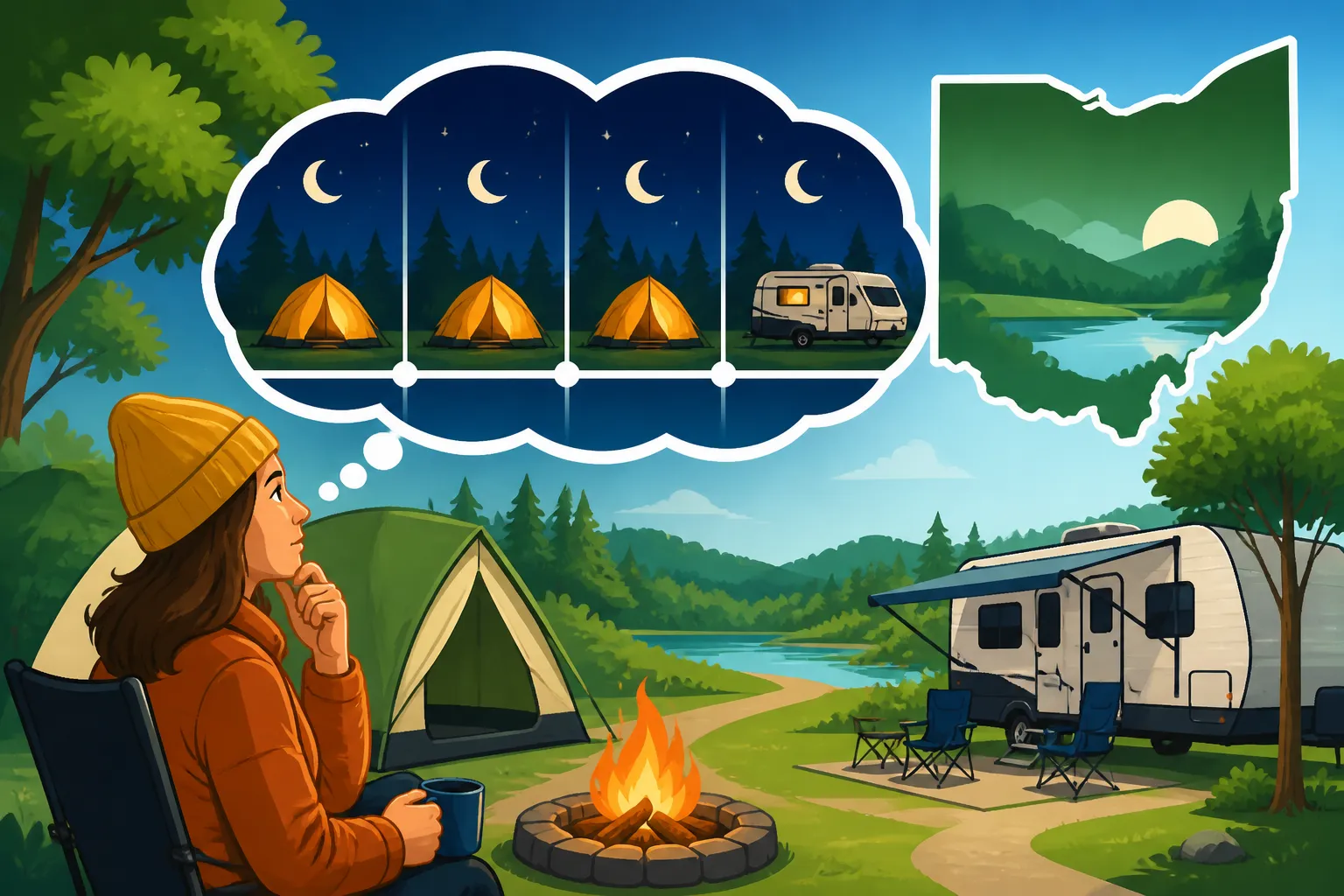
According to the Ohio Department of Natural Resources, the maximum stay in any designated state park campground or other rented overnight facility is 14 days in any 30-day time frame.
That is the central rule for planning a consecutive stay at an Ohio state park. If you have not already stayed in a covered facility during the applicable time frame, you can plan for a stay of up to 14 days. If you have already used some of that allowance, the remaining time may be less. The limit is not described as a fresh allowance for every reservation or every campsite.
The rule matters whether you are camping or renting another overnight facility. It is not only a campground rule, and changing the type of accommodation is not a reliable way to assume that your stay can continue. For questions about a particular rental or how the limit applies to your itinerary, check the Ohio Department of Natural Resources’ current information before arranging dates.
| Planning question | What to keep in mind |
|---|---|
| How long can a qualifying stay last? | According to the Ohio Department of Natural Resources, the limit is 14 days in any 30-day time frame. |
| Does it cover campground stays only? | No. The rule also covers other rented overnight facilities in Ohio state parks. |
| Does a new booking automatically create a new allowance? | Do not assume so. A new booking does not change the stated time frame. |
| Could changing accommodation types matter? | The rule covers designated campgrounds and other rented overnight facilities, so a switch is not a safe workaround to assume. |
| What should you do if your plans are close to the limit? | Confirm how the rule applies to your dates and accommodation with the Ohio Department of Natural Resources. |
The question in the title is about “nights in a row,” but the published limit is framed in days within a time frame. That distinction is worth taking seriously. Do not use a rough calculation based only on the number of nights you expect to sleep at the park. Check the official booking details and ask the Ohio Department of Natural Resources how arrival and departure dates are treated if the answer could affect your plans.
The stay cap is also different from a campground’s availability. A site may be open for a longer stretch, but that does not mean one person may occupy it for that entire stretch. Likewise, a reservation system may allow you to select dates, but an available booking should not be treated as confirmation that your full itinerary complies with the stay limit. Read How Is the Stay Limit Counted at Ohio State Park Campgrounds? for a closer look at the counting question, and verify any uncertainty with the agency.
How the Limit Affects a Consecutive Stay
For someone planning to remain at one park, the practical first step is to look at the whole stay rather than just the reservation for a particular site. A campsite change can make sense for availability, equipment needs, or preference, but the published rule is about the person’s time in a designated campground or other rented overnight facility. A different site number is not, by itself, a reason to assume that a person’s time allowance starts over.
The same caution applies if you switch from a campsite to a cabin, yurt, or another rental. Ohio Department of Natural Resources information describes the cap as covering designated state park campgrounds and other rented overnight facilities. For details about how rental types fit under that rule, see Cabins and Yurts Count Too: Ohio’s Overnight Cap for Every Rental. If an itinerary combines different kinds of stays, ask the agency how to count it instead of treating each accommodation as a separate, independent allowance.
Keep track of previous stays
Before you choose dates, make a record of any recent overnight stays in covered state park accommodations. Include the park, accommodation type, arrival and departure dates, and the person associated with the booking. This record helps you ask a precise question if you are unsure whether a planned stay falls within the applicable time frame.
Do not rely on memory if you have made several bookings, stayed in more than one type of rental, or traveled with other people who handled reservations. A simple itinerary can prevent an avoidable problem: list each stay in date order, then check the planned dates against the published limit. This is a planning aid, not a substitute for the agency’s interpretation if the dates are close or the trip involves complicated bookings.
The rule is stated in terms of a person, so do not assume that changing the name on a reservation makes an otherwise over-limit personal stay acceptable. Similarly, do not assume that sharing a site means each person can ignore their own past stays. For the specific person-versus-site issue, consult Is the Stay Limit Per Person or Per Campsite in Ohio? and confirm your situation with the Ohio Department of Natural Resources.
Treat booking changes cautiously
A booking change can solve a scheduling problem, but it does not necessarily resolve a stay-limit problem. Moving to another campsite, splitting the reservation, or making a second reservation may alter the booking record without changing the period covered by the rule. That is why it is useful to separate two questions:
- Is the accommodation available for the dates?
- Is the person’s full stay permitted under the limit?
Those questions are related, but they are not interchangeable. If you are considering back-to-back reservations, review Back-to-Back Bookings and the Ohio State Park Stay Cap. If a plan involves moving to a different park, Moving to Another Ohio State Park After Your Nights Run Out may help identify the questions to settle. Do not treat either a reservation sequence or a park change as a guaranteed reset.
What Counts Toward Your Plans
The agency’s wording covers a designated state park campground and other rented overnight facilities. That scope is broader than a single campsite listing. When you plan an extended visit, consider every part of the trip that might fall under those categories, rather than focusing only on where the vehicle is parked.
A campground stay may involve different site types, loops, or utility levels. Those distinctions can affect comfort and logistics, but they do not establish a separate stay allowance. If you are comparing site styles, Primitive to Full Hookup: The Range of Ohio State Park Campsites and Which Ohio State Park Hookup Level Fits a Tent, Van or Trailer? can help with the accommodation choice. The stay-limit question remains separate: confirm the dates and applicable rule rather than assuming a more basic or more fully serviced site is treated differently.
Rentals deserve the same careful review. A cabin or yurt can feel like a different kind of trip from tent or RV camping, but the state park rule includes other rented overnight facilities. Before combining a campground reservation with a rental, check whether both parts of the itinerary are covered and how the agency applies the limit. The title Lodge Room, Cabin or Sherman Cabin: Ohio State Park Stays Compared can help you compare accommodation types, but use official information for the rule that applies to your actual booking.
Consider everyone’s itinerary separately
A group trip can make the stay cap harder to track. People may arrive on different dates, leave early, or rotate between a campsite and a rental. Keep a separate record for each person whose stay needs to be checked. Do not assume that the reservation holder’s dates are the only dates that matter, or that a group’s overall booking length answers whether each person’s stay is permitted.
This is especially useful when one person is joining for part of a trip while another remains for the full stay. Ask the Ohio Department of Natural Resources how the published person-based limit applies to the actual arrangement. Give the agency the planned dates, the facilities involved, and who will occupy each one. Clear details are more useful than a general question such as whether “the reservation” is allowed.
If several households are traveling together, the booking arrangement may also have its own conditions. Group sites and multiple family reservations can help with logistics, but they do not replace checking each person’s covered stays. Group Camping in Ohio State Parks: Group Camps, Loops and Limits and Group Camp or Several Family Sites for a Big Ohio State Park Trip? can help with choosing a setup. For the time limit, continue to rely on the agency’s published rule and its answer to your specific question.
Do not confuse an available date with permission to stay
A reservation calendar answers an availability question: whether a particular accommodation can be booked for a date. It may not make the underlying stay-limit question obvious, especially when an itinerary uses several reservations or facilities. For a trip near the cap, record the full sequence of dates and confirm the plan before relying on a booking.
If the system accepts a booking that appears to extend a stay beyond the stated cap, do not assume that the booking itself settles the issue. The stay rule and the mechanics of placing reservations are different concerns. When an Ohio Park Booking Breaks the Stay Limit: What Happens and Stay-Limit Workarounds the Ohio Booking System Flags address the kinds of booking questions that can come up. For a decision about your own itinerary, contact the agency through its official channels and retain the response with your plans.
Why a Park Change or New Reservation May Not Solve It
It is tempting to think of a stay limit as a campsite limit: leave one site, move to another, and begin a fresh stay. But the rule is framed around a person staying in covered overnight facilities during a time frame. That wording is why a site change should not be treated as a reset.
Moving to another state park may sound like a more substantial change, but it is still unwise to assume that a new park means a new allowance. The published rule covers designated campgrounds and other rented overnight facilities within state parks, and it describes the limit for a person. Ask the Ohio Department of Natural Resources how it applies to a multi-park itinerary before planning consecutive bookings. Multi-Park Camping Road Trips in Ohio: Stay Limits and Bookings is useful for thinking through the logistics, while the agency remains the source for interpreting the rule.
A break between reservations also needs careful thought. Do not assume that a short gap automatically restarts the time frame, or that a longer gap has a particular effect, unless the official information or agency confirms it for your dates. The published wording refers to a time frame, so keep the complete sequence of stays available when you ask.
Scenarios to check before you commit
Some plans are straightforward: a single stay that falls comfortably within the limit, with no other relevant stays in the period. Other plans deserve confirmation before you finalize travel. For example:
- You have already camped at an Ohio state park during the relevant period.
- You plan to change campsites during one continuous trip.
- You plan to leave one park and continue at another.
- You plan to switch from a campsite to a cabin or another rental.
- Several people will take turns occupying a site or rental.
- You have multiple reservations that overlap or follow one another closely.
- Your intended arrival or departure dates are close to the stated limit.
These are not separate exceptions. They are situations where the details may affect how you should count or interpret the itinerary. Explain the full plan to the Ohio Department of Natural Resources rather than presenting each reservation as if it were unrelated to the others.
For changing dates or reservations, also distinguish between the stay cap and the booking policy. A date adjustment may be permitted under the reservation rules but still leave you with a stay-limit question. Changing or Canceling an Ohio State Park Booking: The Full Policy covers reservation changes; it does not replace checking the overnight cap.
Planning a Trip That Fits the Rule
A trip can still feel substantial without stretching a single state park stay to its maximum. The key is to design the itinerary around the rule rather than trying to work around it after reservations are made.
Start with the dates and accommodation
Write down the full planned travel period first. Then identify where you expect to sleep each night and whether each stay is in a designated campground or a rented overnight facility. Mark any previous stays that may fall within the same time frame. This overview can reveal a potential issue before you have organized transportation, made plans with companions, or packed for a long visit.
If the trip includes a mix of camping and rentals, list each accommodation in order. Do not leave a gap in the itinerary just because you have not decided between a campsite and a cabin yet. Treat the undecided nights as unresolved and ask the agency how the rule applies to the alternatives you are considering.
For a camping-only trip, compare site features separately from the stay limit. A tent-only site, an electric site, and a full-hookup site may suit different equipment, but the type of site does not automatically change the time frame. For accommodation research, Choosing an Ohio State Park for Camping: Questions to Settle First and Finding Hookup Details on an Ohio State Park Campground Page can help you make a practical choice without confusing site features with stay eligibility.
Get a clear answer for an unusual itinerary
When contacting the Ohio Department of Natural Resources, provide the details that allow the agency to answer the actual question:
- The dates you have already stayed in a covered facility, if any.
- Your planned arrival and departure dates.
- The state parks and accommodation types involved.
- Whether the itinerary includes a site change, park change, or rental change.
- Who will stay for each part of the trip.
Ask directly whether the proposed sequence is within the published stay limit, and whether the agency has guidance on how your arrival and departure dates are counted. If you receive clarification, keep it with the itinerary so everyone arranging the trip is working from the same information.
If the answer changes how long you can remain at one park, consider alternatives before the trip begins. You might shorten the stay, plan a genuine break away from covered overnight facilities, or organize a separate destination for the remaining dates. Whether a particular break or change affects the calculation is a question for the agency; do not assume it based on a booking-system result.
Build flexibility into the reservation plan
A flexible itinerary is easier to adjust than one built around a single long reservation. Consider keeping your preferred dates, alternative dates, and possible accommodation types together in your planning notes. Check the current reservation information for each option and confirm the stay-limit issue before committing to a sequence that depends on an interpretation.
This is useful for popular travel periods, when a change of dates or facility may leave fewer alternatives. It is also helpful when traveling with a group: one person can keep the date record, while everyone confirms their own participation. Make sure the final itinerary is shared with the people booking and occupying the facilities.
For general preparation, First Camping Trip at an Ohio State Park: What the Weekend Looks Like can help you anticipate the practical parts of a stay. If the plan involves combining different accommodation types, Mixing Tent Campers and Cabin Guests on One Ohio State Park Trip may help with group logistics. Neither planning approach changes the stay limit; it simply makes it easier to build a trip that fits it.
If You Need More Time at the Same Park
If you want to stay longer than the published limit allows, the safest planning choice is to avoid relying on a workaround. A second campsite, a different loop, a new reservation, or a change from camping to a rental does not establish that your stay may continue. The rule’s coverage of campground and rented overnight facilities is exactly why those changes need to be checked rather than assumed.
Start by reviewing your complete personal itinerary, including recent stays in covered facilities. Then ask the Ohio Department of Natural Resources whether the dates you want are allowed and how the agency counts the relevant period. If the answer is that the proposed stay does not fit, revise the plan before arrival. Do not wait until the trip is underway to discover that a booking sequence is not a valid way to extend the stay.
A different destination can be a good alternative when you want a longer vacation. You can compare other Ohio state parks or choose another kind of trip, but first confirm how your existing stays affect the dates you are considering. A move can improve the travel experience without necessarily changing how the rule applies to a person. For ideas on moving between parks, Moving to Another Ohio State Park After Your Nights Run Out and Multi-Park Camping Road Trips in Ohio: Stay Limits and Bookings can help you plan the route and questions to ask.
If the trip is flexible, you can also choose a shorter stay at the first park and spend the rest of the vacation elsewhere. The destination after that stay could be another form of lodging or a different kind of activity; what matters for compliance is not to treat a change in scenery or booking as an automatic reset. Check the rules for any other accommodation you plan to use, since its policies may differ from those of a state park campground.
A longer trip is easiest to manage when you make the stay limit part of the first planning conversation. Decide who is traveling, where each person will sleep, and what dates they will be there. Then verify the full sequence against Ohio Department of Natural Resources guidance. That approach is more dependable than trying to solve the problem by changing a reservation after the dates are already set.
Frequently Asked Questions
Can I stay at one Ohio state park for 14 days in a row?
The Ohio Department of Natural Resources’ published limit allows a person to stay up to the stated maximum within the relevant time frame, provided prior covered stays do not reduce the available time. Confirm the way your exact arrival and departure dates are counted.
Does moving to another campsite restart my stay?
Do not assume it does. The Ohio Department of Natural Resources frames the limit around a person’s stay in covered overnight facilities, not simply the number attached to a campsite. Ask the agency about a plan that depends on moving sites.
Can I switch from a campground to a cabin or yurt to stay longer?
The rule covers campgrounds and other rented overnight facilities. A change in accommodation type is not a dependable workaround; confirm the full itinerary with the Ohio Department of Natural Resources.
Does a new reservation start a new time frame?
A new reservation does not, by itself, show that the stay limit has reset. Check the dates of all relevant stays and ask the Ohio Department of Natural Resources how the rule applies to the complete sequence.
Where should I check if my itinerary is close to the limit?
Use the Ohio Department of Natural Resources’ official information and contact channels. Share your dates, accommodation types, and any prior stays so the agency can address the specific itinerary.
Sources
- Ohio Department of Natural Resources — Ohio State Parks Reservation Policy (checked November 23, 2026)
Disclaimer
This article is for general informational purposes only and does not constitute professional advice. Laws, prices and regulations vary by location and change over time. Consult a qualified professional for guidance on your specific situation. Ohio Camping & RV is not a government agency and is not affiliated with any government agency.