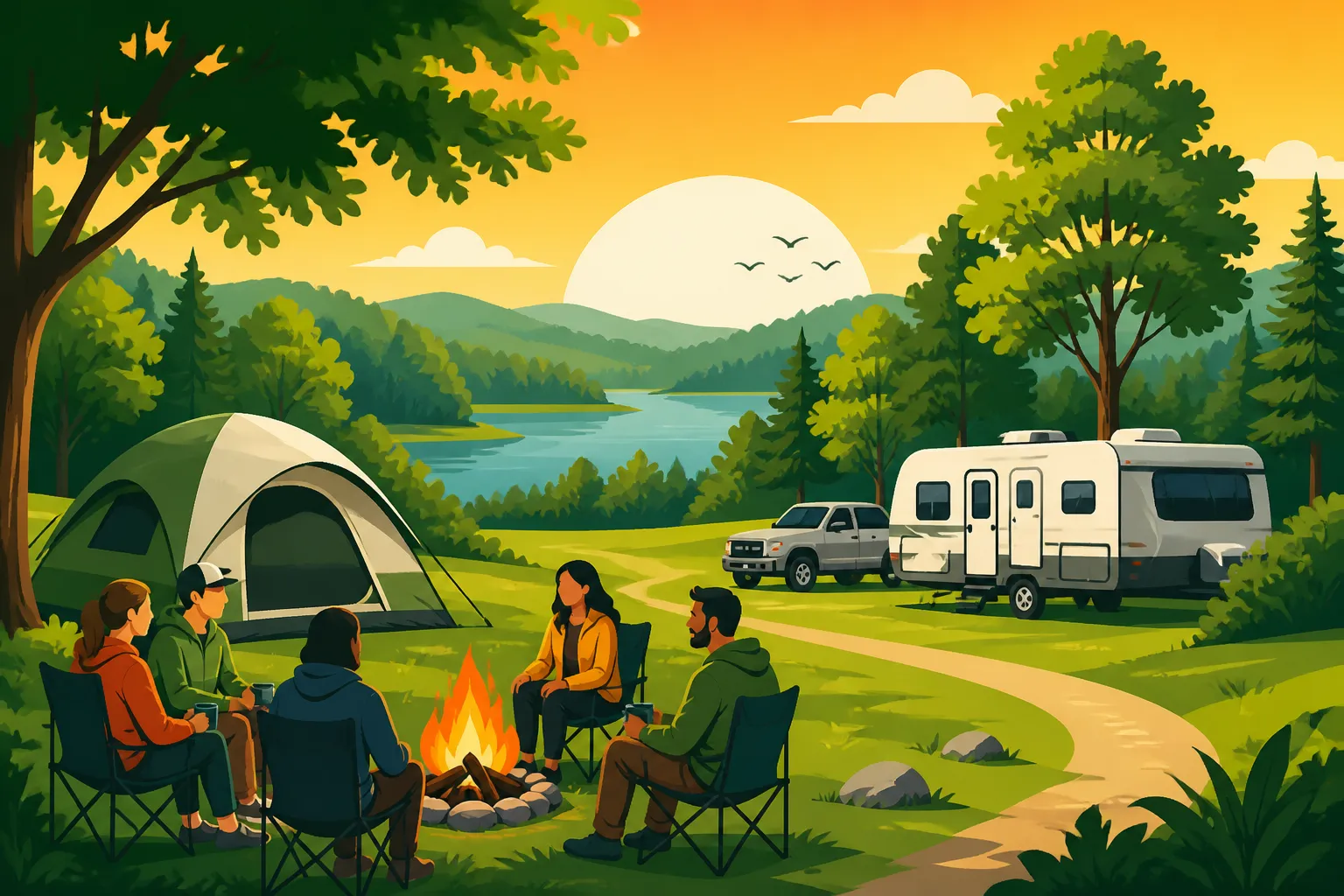
Group Camping in Ohio State Parks: Group Camps, Loops and Limits
A group trip can be easier to organize when everyone shares a designated camp, but Ohio State Parks use more than one kind of group-camping setup. The main questions are whether your party fits the site’s limit, what facilities and power are available, and whether you need a group camp or several regular campsites. Here’s how to compare those options and check the details before planning around them.
Group camps and group-camping loops are not the same setup
“Group camping” can describe a purpose-built group camp or a group-camping site within a campground loop. Those arrangements may suit different parties, so start by identifying the exact type of site offered at the park you are considering. The label alone does not tell you what facilities are on site, how close the camp is to other visitors, or whether it has electric service.
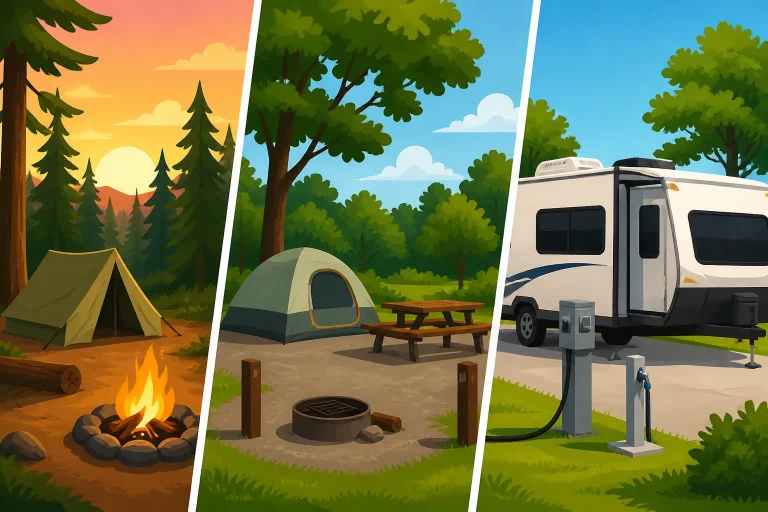
A group camp is intended for a party to camp together in a designated area. A group-camping loop, by contrast, may be a distinct part of a larger campground. The layout can affect how your party handles arrivals, shared gear, vehicles, meals, and quiet neighbors. It may also affect whether the site works for a group that wants a more separate setting or one that would rather be near the main campground.
Ohio Department of Natural Resources (ODNR) listings show that the details vary by park. For Mohican, the Ohio Department of Natural Resources says four primitive group camps offer non-electric sites for up to 25. East Harbor offers 10 primitive Group Camping sites in their own loop of the campground. The Ohio Department of Natural Resources says each group-camping site allows a maximum of 50 campers.
Those examples illustrate why it is useful to check the listing for the specific park and campsite rather than assume that a group site at one park resembles a group site elsewhere. A maximum capacity also does not tell you whether a campsite will feel comfortable for your particular party. People, tents, shared equipment, and vehicles all need room. If the stated maximum is close to your expected attendance, ask the park how the limit is applied and what the site layout can accommodate.
There are additional differences among categories in ODNR’s park information. The Ohio Department of Natural Resources describes a park setup this way: Three group camps offer primitive camping (no electric service). Another listing describes a different mix: five group camps, one Backpack camp, and one Equestrian group camp. These descriptions are reminders to read the specific park’s information closely; they do not establish that all camps in those categories have the same facilities or rules.
If your party is weighing a group camp against booking several individual sites, compare the practical differences before choosing. Group Camp or Several Family Sites for a Big Ohio State Park Trip? can help frame that decision. For a broader look at how Ohio’s group-camp categories work, see Group Camps at Ohio State Parks: Booking and Adult Supervision.
Decide what your group needs before picking a park
It is tempting to begin with the park or activity and sort out the campsite afterward. For a group, it often works better to start with the party’s needs. Make a realistic estimate of who is coming, what sleeping arrangements people will use, and how much shared space the group needs. Then compare those needs with the campsite description and its stated maximum.
A useful planning conversation covers more than attendance:
- Will everyone sleep in tents, or will some people bring a different camping setup?
- Does anyone need access to electric service?
- Will the group prepare meals together or separately?
- Do people need to be close to a restroom, showerhouse, or other campground facility?
- Are there young campers who need adult supervision?
- Will people arrive together, or should the group plan for staggered arrivals?
- Do some participants need an accessible campsite or a shorter route from parking to the sleeping area?
- Is the group comfortable sharing a site with a more rustic setup, or does it need additional facilities?
These are planning questions, not guarantees about what any particular Ohio group camp provides. Check the campsite listing for the actual facilities and confirm anything important with the park before you commit your group to the trip. If you need a specific feature, such as electricity or nearby showers, do not infer that it is available from the words “group camp” or “primitive.” Ask about the campsite itself.
Group size deserves a careful check. The maximum can be a firm eligibility limit, but it is not necessarily a measure of how spacious a site will feel. A group can be below the posted maximum and still find the area crowded if many people bring large tents, cooking equipment, or bulky shared supplies. Ask whether the stated capacity includes all campers and whether tents or other camping units have to fit within a defined area. Do not rely on a rough head count if your group is close to the listed cap.
The group’s composition matters, too. Families with children may need more room for supervision and a clear plan for moving around the campground. A club or troop may need designated adults who understand the site’s expectations. A reunion group may include people who prefer separate sleeping arrangements and shared gathering space. Thinking through these differences helps you choose a site that suits the group, rather than trying to make a site work after the booking is in place.
The comparison in How Big a Group Can an Ohio State Park Group Camp Hold? is useful when capacity is the deciding factor. If your group is too large for a single site, compare the logistics of separate campsites with those of a designated group area, rather than assuming that nearby sites can be treated as one reservation.
Check capacity, adult guidance, and the group’s responsibilities
A group-camp booking does not remove the need to plan who is responsible for the people attending. Ohio Department of Natural Resources states: Parental permission required for campers under 18; adult guidance for group camps.
That requirement is important for groups with younger participants. Before the trip, establish who is accompanying the group, who is responsible for communicating with parents or guardians, and how the adults will keep track of participants at the campground. The exact arrangements will depend on the group and the park’s rules, so confirm what the park expects instead of treating a general plan as a substitute for official guidance.
For families or organizations, it can help to make responsibilities clear before anyone arrives. Decide who is the lead contact for the group, who will handle check-in or communicate with park staff, and how participants will know where to go if they become separated from the rest of the party. Share the campsite location and basic arrival plan with the adults who are attending. Make sure the people responsible for supervision know which parts of the campground the group plans to use and what boundaries the park sets.
Capacity should be checked alongside supervision, not treated as a separate administrative detail. A group that is within the stated limit still needs enough adults to guide its participants and manage everyday campground routines. Conversely, the presence of adults does not make it acceptable to exceed a site’s maximum. If your head count changes after you have selected a camp, check with the park before relying on the original plan.
If participants will arrive in separate vehicles, choose a simple meeting procedure. A group leader can share the official campground location, the name or identifying details of the site, and a plan for what to do if someone arrives before the main party. Do not assume that a group camp has a staffed check-in point, that every arrival can drive directly to the site, or that there is room to park all vehicles at the camp. Those details depend on the location and should be confirmed.
For groups organized through a school, club, troop, or community organization, put the important information in writing for participants and guardians. Include the site’s capacity, the group’s arrival plan, the adults responsible for guidance, and the facilities the group has verified. A clear description helps people arrive with realistic expectations and makes it easier to spot a mismatch before the trip.
For more on the adult role and how group-camp rules fit into planning, see Group Camps at Ohio State Parks: Booking and Adult Supervision. It is also worth comparing Can Kids Camp Alone at an Ohio State Park Group Camp? if a group is deciding how to handle young participants.
Compare facilities and setting, not just the maximum
A site’s capacity may be the first fact a group notices, but it should not be the only one. A campsite that can legally accommodate your party may still be a poor fit if it lacks a feature your group depends on or does not offer the kind of setting you want. Review the full listing and map, then ask the park about any detail that could change the trip.
Start with power and water. ODNR identifies some group camps as primitive and without electric service. That can be workable for a group prepared to camp without powered equipment, but it changes meal planning, lighting, charging, and the way people manage medical or mobility needs. Do not assume that an electric connection is available because a nearby campground has powered sites. Ask specifically about the group camp you are considering.
Next, check sanitation and water access. A description may mention primitive camping without explaining every facility a group will use. Find out what restrooms, showerhouses, drinking-water sources, and waste-disposal options are available, and whether they are near the group site. The word “primitive” does not answer those questions on its own. A group that includes young children, older adults, or campers with access needs may need to give these details extra weight.
A map can help you understand the site’s relationship to the rest of the campground. Look for the route from parking, the distance to common facilities, nearby roads, and whether the group area is a separate loop. But maps and listing photos do not always answer practical questions about terrain, walking routes, or how vehicles are handled. Ask the park to clarify anything that affects your group’s ability to use the site.
The setting matters for the group’s style of trip. A separate group area may help a party gather together, while a site in a larger campground loop can place the group within a broader campground setting. Neither is automatically better. A family gathering may prioritize easy access to shared facilities; an organized outdoor group may prefer a more primitive area. What matters is matching the setting to the group’s expectations and following the park’s rules.
If showers and pools are part of the plan, confirm whether group campers can use them and what conditions apply. Do not assume that access follows from the campsite category. Can Group Campers Use Ohio State Park Showers and Pools? addresses that question. For broader comparisons of group-camp types and limits, How Big a Group Can an Ohio State Park Group Camp Hold? is another useful starting point.
Understand the trade-off between a group camp and several regular sites
A group camp can make it easier to gather in one designated area, but it is not the only way to organize a large trip. Several individual campsites may offer more flexibility in sleeping arrangements or let households have their own spaces. The right choice depends on the park’s available options, the group’s size, and what the party values most.
A group camp is worth investigating when the group wants a shared place to organize the trip and the listed capacity and facilities fit. It may be a natural fit for clubs, family gatherings, or other groups that plan to spend time together at camp. Still, do not assume that a group site comes with a particular table, shelter, fire ring, parking arrangement, or private gathering area unless the official description confirms it.
Several regular sites can make sense when people prefer separate sleeping areas or when the group camp’s capacity or facilities do not fit. But separate reservations can make coordination more complicated. Sites may not be adjacent, and proximity should not be assumed unless the official booking map or park confirms it. A group that books individual sites should decide where it will gather and how participants will move between sites without disrupting other campers.
A comparison can help clarify the choice:
| Planning question | Group camp or group-camping loop | Several regular campsites |
|---|---|---|
| Where will everyone gather? | Check whether the designated area fits the group’s intended use. | Identify a gathering plan that does not depend on sites being adjacent. |
| How many people can attend? | Compare the party’s total attendance with the stated site maximum. | Confirm the capacity and rules for each campsite. |
| What facilities are available? | Verify facilities for the specific group area. | Compare the facilities of the selected individual sites. |
| How will people sleep? | Confirm the usable space and any relevant restrictions. | Households may have separate sites, subject to each site’s rules. |
| How will vehicles be handled? | Ask where group vehicles may park and whether all can fit. | Check the parking allowance and location for each site. |
| What if the party changes size? | Ask the park how a change affects the group-site booking. | Check how changes to multiple bookings are handled. |
This table is a decision tool, not a statement that every park offers all of these options. Site availability, layout, and rules are park-specific. When the group is weighing separate sites, Group Camp or Several Family Sites for a Big Ohio State Park Trip? offers a more focused comparison.
Vehicle arrangements deserve particular attention. A group may have more drivers than the campsite can accommodate, and vehicles may need to park in a designated area rather than beside tents. Do not assume the maximum camper count is also a vehicle allowance. Ask about parking for the exact site, including trailers or extra vehicles if relevant. Vehicle Limits When Parking at Ohio State Park Group Campsites can help you identify the questions to ask.
Organize booking, arrival, and shared gear around the site
Once you have found a site that appears to fit, verify the booking details through the official park or reservation information. Confirm that the reservation is for the group area you intend to use, not a similarly named campground or a collection of individual sites. Read the current listing carefully, including capacity, facilities, access, and any park-specific instructions. If a critical detail is unclear, ask the park before the group makes plans that depend on it.
Keep a written record of what you have confirmed. For a group trip, that can include the site name, its capacity, the facilities the park says are available, parking instructions, the arrival plan, and any questions still awaiting an answer. Share the relevant details with the adults and participants who need them. This reduces the chance that one person assumes a facility is present while another has planned around its absence.
Plan arrivals with the site’s layout in mind. If people will reach the park at different times, tell them where to meet and what they should do if they cannot find the group immediately. Do not promise that the group can drive into the site or unload at a particular spot until the park confirms it. Some sites may require carrying gear from a parking area or following a specific access route; verify the arrangement for your chosen camp.
Assign shared gear before departure. Group trips can leave people short on essential items when everyone assumes someone else has packed them. Choose who brings cooking equipment, lighting, water containers, first-aid supplies, and other shared items based on the facilities the park confirms. If the camp has no electric service, plan accordingly rather than depending on powered appliances or charging at the site.
Have each household or participant prepare for the verified campsite rather than for an imagined version of it. A primitive site may call for a different packing plan than a developed campground. The group can use Packing List for a Primitive Group Camp at an Ohio State Park to organize what to bring, while checking the specific listing for any supplies or facilities that affect the final list.
Shared meals also need a practical plan. Decide whether the group will cook together, use individual cooking gear, or combine the two approaches. Confirm what cooking arrangements are allowed at the site and do not assume that equipment or a built-in cooking area will be provided. Make a clear plan for food storage, cleanup, and keeping shared supplies organized. For groups with varied dietary needs, identify who is responsible for bringing suitable food and how meals will be coordinated.
A group can also reduce campsite friction by setting expectations before arrival. Agree on how the party will handle noise, shared space, trash, and movement through the campground. Remind everyone that a group site is still part of a park with other visitors, and follow the posted rules and staff instructions. For general group-camp rules, Campground Rules at Ohio State Parks: Statewide Basics, Park Extras is a helpful companion.
Confirm park-specific details before you finalize the trip
Ohio’s group-camping options are not interchangeable. The examples at Mohican and East Harbor show differences in capacity and layout, while ODNR’s other descriptions distinguish group camps from backpack and equestrian group camps. Treat each park listing as its own set of facts. A camp’s category does not guarantee that it has the same services, access, or restrictions as another camp with a similar name.
Before finalizing plans, check the current official information for the park and site. Confirm the following:
- The site’s exact name and category.
- The maximum number of campers and how the park counts them.
- Whether the camp has electric service.
- The location and availability of restrooms, showers, and drinking water.
- How people reach the site from the parking area.
- Where vehicles may park and whether trailers are permitted.
- Whether the site is separate from the main campground or part of a campground loop.
- Any rules for tents, cooking, fires, quiet, and shared use.
- Whether the facilities your group wants to use are open to group campers.
- How the park wants the group to handle arrival, check-in, or changes in attendance.
These are questions to verify, not rules that apply universally. A park’s own information is the best place to confirm its procedures. If the listing does not answer a question that could affect safety, access, or comfort, contact the park through its official website and ask about the specific campsite.
Build a backup plan in case the group camp is unavailable or turns out not to suit the party. Options may include choosing another group camp, splitting the party across regular campsites, or changing the trip’s timing. Availability and park rules will determine what is possible. Avoid booking separate sites on the assumption that they will be adjacent or that the group can use them as a single shared area.
Recheck the details close to departure, especially if the group depends on a particular facility or access arrangement. Park information and conditions can change. Make sure the people leading the group have the same current instructions as the rest of the party. A brief final check can prevent avoidable confusion when a large group arrives with gear, vehicles, and different expectations.
Frequently Asked Questions
Are Ohio State Park group camps all primitive?
No. ODNR listings vary by park and camp. Check the specific site information for electric service, facilities, access, and other details rather than assuming the setup is the same across the state.
Can a group use several regular campsites instead?
That may be an option if suitable sites are available and the park’s rules allow the plan. Confirm each site’s capacity and location, and do not assume separate reservations will be next to each other.
What should a group do if its attendance is close to a site’s maximum?
Ask the park how it applies the stated limit and what the site can accommodate. Do not rely on an estimated count or assume that the camper limit also covers vehicles.
Do campers under 18 need adult guidance at group camps?
Yes. The Ohio Department of Natural Resources says groups must plan for parental permission for campers under 18 and adult guidance at group camps. Confirm the park’s specific expectations before the trip.
Sources
- Ohio Department of Natural Resources — Camping Rules for Ohio State Parks (checked November 23, 2026)
- Ohio Department of Natural Resources — Mohican State Park Campground (checked November 23, 2026)
- Ohio Department of Natural Resources — East Harbor State Park Campground (checked November 23, 2026)
- Ohio Department of Natural Resources — Hueston Woods State Park Campground (checked November 23, 2026)
- Ohio Department of Natural Resources — Caesar Creek State Park Campground (checked November 23, 2026)
Disclaimer
This article is for general informational purposes only and does not constitute professional advice. Laws, prices and regulations vary by location and change over time. Consult a qualified professional for guidance on your specific situation. Ohio Camping & RV is not a government agency and is not affiliated with any government agency.